To design a garden in the Surrey Hills is to engage in a continuous conversation with England’s most complex geological fault lines. Within a four-mile radius between Dorking and Guildford, the subsoil transitions violently: from the alkaline, moisture-deprived Upper Cretaceous chalk scarps of the North Downs to the iron-rich, acidic Lower Greensand of the Hurtwood and Leith Hill. Plant an imported Italian specimen tree without understanding this boundary, and the estate soil will starve its rootball within twelve months.
For owners of country houses across Bramley, Shere, and the private enclaves of Elmbridge, the days of chemically supported English lawns and rigid box-hedging are over. Today’s estate landscape architecture focuses on vernacular stone, drought-resilient micro-topography, and structural permanence.
The Return of Vernacular Bargate Stone
- Core Material
- Godalming Bargate Sandstone
- Key Technique
- Galleting with ironstone chips in lime mortar
- Best For
- Retaining steep Greensand slopes & thermal garden mass
- Featured Studio
- Surrey Hills Garden Design
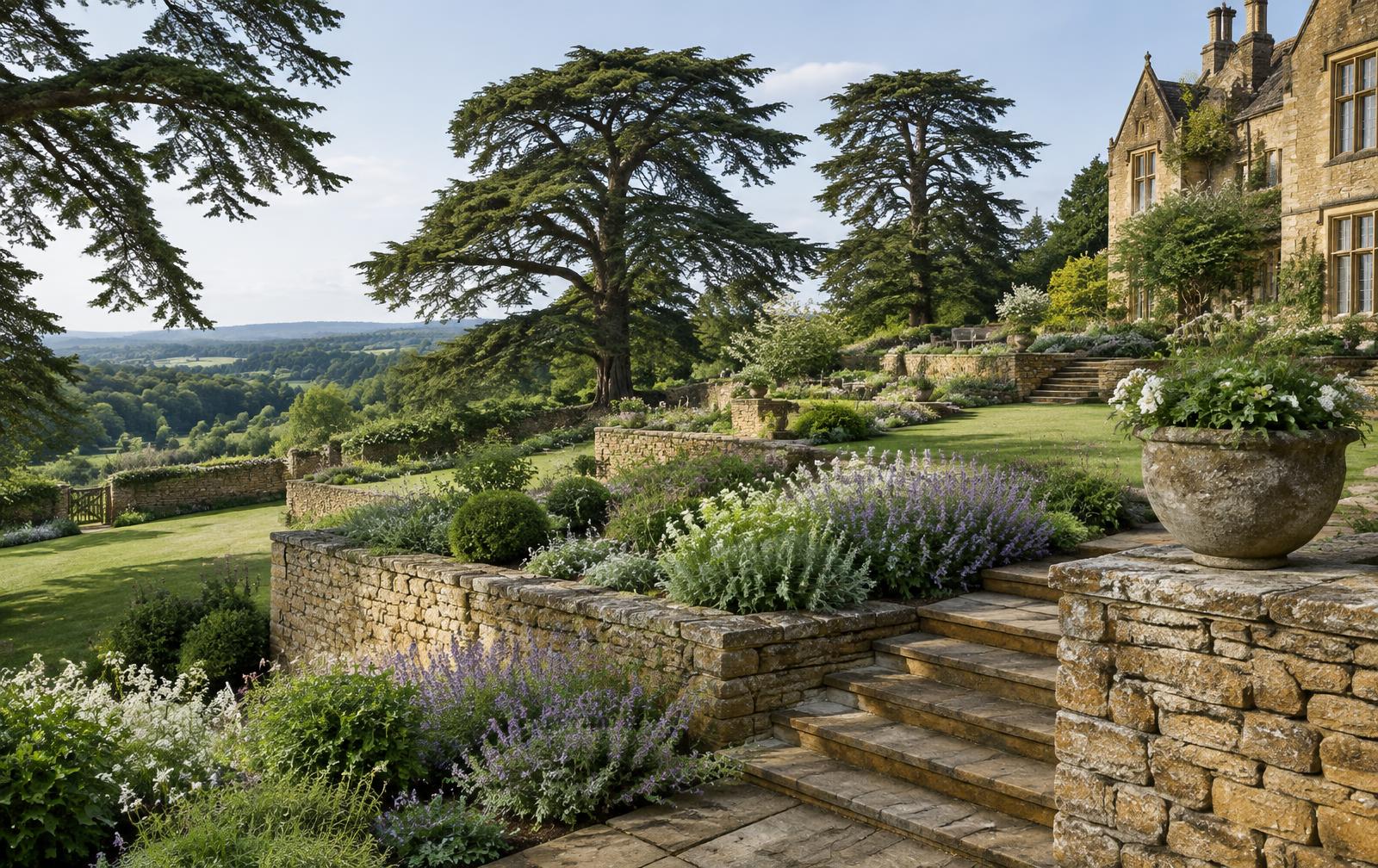
The most visible marker of this shift is the revival of Bargate stone terracing. Sourced historically from quarries around Godalming, this coarse, calcareous sandstone with high iron and glauconite content has a distinctive golden-honey hue that weathers to soft olive-grey.
Landscape practices are increasingly specifying hand-dressed Bargate rubble walls with galleting—the historic technique of pressing small chips of dark ironstone into wet lime-mortar joints. These heavy stone retaining walls absorb solar heat during clear Surrey days, radiating warmth back into terraced microclimates along south-facing hill contours. In steep gardens falling away from the Greensand ridge, dry-stone and lime-bonded terracing manages sudden downpours without the hydraulic failure risks associated with concrete backing walls.
The Gertrude Jekyll Legacy in Modern Practice
Every significant garden in south-west Surrey lives in the long shadow of Gertrude Jekyll, whose home at Munstead Wood in Godalming established the English border tradition. Modern Surrey landscape architects are stripping away high-maintenance annuals and returning to her original principles:
Drifts Over Blocks: Mass plantings of Euphorbia, Stipa gigantea, and native ferns running in asymmetrical drifts that visually blur the boundary between private formal lawns and ancient semi-natural woodland.
Textural Foliage: Prioritising structural foliage—cardoons, hornbeam buttresses, and dark English yew—that holds its silhouette through the low winter mist of the Wey Valley long after petals have dropped.
Native Woodland Transitions: Designing the outer periphery with hazel coppice, sweet chestnut (Castanea sativa), and field maple, anchoring the cultivated garden into the surrounding designated Area of Outstanding Natural Beauty.
Water Engineering and Sunken Lawns
With drier summers and sudden, high-intensity autumn rainfall becoming the regional pattern, progressive Surrey practices are replacing decorative concrete water features with subterranean rainwater harvesting cisterns disguised as naturalistic dew ponds.
By regrading estate terrain to guide stormwater runoff through dry gravel rills into sunken bioswales, gardens remain lush through midsummer hosepipe bans without relying on mains irrigation. Paired with sweet chestnut pergolas sourced from local timber workshops, the modern country estate landscape is engineered not as a decorative backdrop, but as a resilient, living ecosystem.